Why Indian Skin Faces More Environmental Stress Than Ever (And What That Means for Your Skin Barrier)
Pollution, UV, heat, humidity, sweat, hard water and friction all hit Indian skin at once. Here is what that does to your skin barrier, and a practical, no-hype plan to lower the load.

TL;DR, the quick version
- Indian skin deals with an unusual combination of stressors at the same time: high air pollution, intense year-round UV, heat, humidity, sweat, hard water, dust and friction.
- Together these can weaken your skin barrier, the outer layer that keeps moisture in and irritants out. A strained barrier means more dryness, sensitivity, breakouts, dullness, and, for most Indian skin, dark spots and uneven tone.
- The smartest response is not a 10-step routine. It is lowering your skin's total environmental load and keeping the barrier calm and strong.
- The single highest-value habit is daily sunscreen, because melanin-rich skin pigments easily.
- Hypochlorous acid (HOCl) is one optional, gentle tool, handy as a rinse after sweat or pollution exposure. It is not a cleanser, not a sunscreen, and not a cure. We will be clear about where it helps and where it does not.
On this page
- Most skincare advice wasn't written for India
- Your Skin Barrier, in 60 Seconds
- Air Pollution: India's Invisible Skin Stressor
- UV: Why Indian Skin Spots Instead of Burns
- Heat, Humidity, and Sweat
- Hard Water: The Overlooked Stressor
- Dust and Friction: The Helmet-and-Mask Problem
- When Stressors Stack: Your Total Skin Load
- Why Barrier Care Beats Chasing Perfect Skin
- Where Hypochlorous Acid Fits In
- Why Simpler Routines Often Win
- How to Lower Your Skin's Environmental Load
- Frequently asked questions
- Before You Buy Any HOCl Product
- The Bottom Line
- Sources
Most skincare advice wasn't written for India
Open almost any skincare guide and you will find advice built around one idea: your skin type. Oily, dry, combination. It is useful, but it quietly assumes you live somewhere mild, temperate weather, clean-ish air, soft water, gentle sun. That describes a lot of Europe, Korea and North America, where much popular skincare content comes from.
It does not describe a typical day in Delhi, Patna, Mumbai or Bengaluru.
Indian skin lives in a much harder environment. Your skin is an organ that responds to everything it meets during the day, not just the products you put on it. And in India, what it meets is a lot: some of the most polluted air on earth, strong UV nearly all year, heat, humidity, sweat, hard tap water, and road dust.
This article maps out those stressors honestly, explains how they add up on your skin barrier, and gives you a practical, no-hype plan to lower the load.
Your Skin Barrier, in 60 Seconds
Almost everything below comes back to one structure, so it is worth 60 seconds.
Picture the outer layer of your skin (the stratum corneum) as a brick wall. The skin cells are the bricks. Holding them together is mortar made of fats called ceramides, cholesterol and fatty acids. This wall has two jobs: keep irritants, microbes and pollution out, and keep water in (stratum corneum barrier basics).
When the wall is damaged, water escapes too fast. Scientists measure this as transepidermal water loss (TEWL), and higher TEWL is a standard signal that the barrier is under strain (TEWL and barrier function).
There is one more piece: the acid mantle. Healthy skin sits at a slightly acidic pH of roughly 4.5 to 5.5, and that acidity keeps the barrier's repair enzymes working and the skin's microbiome balanced. Push skin too alkaline, harsh soaps and some hard water do this, and the barrier weakens, water loss rises, and skin becomes more prone to irritation, eczema and acne (the acid mantle and skin pH; why barrier acidity matters).
Keep that wall in mind. Every stressor below is, in some way, an attack on it.
 Tap to enlarge
Air Pollution: India's Invisible Skin Stressor
Most people think of air pollution as a lungs problem. Your skin is also directly exposed, all day.
And in India, the exposure is extreme. India's average PM2.5 level in 2025 was around 48.9 ug/m3, roughly ten times the World Health Organization's guideline, and 66 of the world's 100 most polluted cities are in India (World Air Quality Report 2025 summary; live India air-quality data, IQAir). During winter, Delhi's PM2.5 has averaged around 159 ug/m3 across the season (India air-quality snapshot).
What is PM2.5? Particulate matter 2.5 micrometres or smaller, particles so tiny they settle onto skin, slip in through hair follicles and sweat glands, and can penetrate a barrier that is already compromised (particulate matter and the skin).
What it does, in plain terms. Pollution drives oxidative stress: it floods the skin with unstable molecules called free radicals that overwhelm the skin's natural defences. Those free radicals damage the barrier's lipid mortar, raise water loss, disturb skin pH and the microbiome, and switch on inflammation (how air pollution damages skin; PM2.5 triggers oxidative stress in skin cells).
What you may notice: dullness, more sensitivity, worse acne, faster ageing, and, for melanin-rich skin especially, more pigmentation and dark spots (pollution, climate and skin health review).
No facial mist neutralises pollution. The proven move is physical: actually cleansing pollution particles off at the end of a high-exposure day, plus supporting the barrier so particles cannot get a foothold.
UV: Why Indian Skin Spots Instead of Burns
This is the section most global skincare articles get wrong for Indian readers, because they are written with lighter skin in mind.
Most Indian skin is rich in melanin (Fitzpatrick types III to V). That higher baseline pigment gives some natural protection against sunburn, but it makes the skin highly reactive in a different way: it makes pigment. Instead of turning red, it turns brown. The result is tanning, dark spots, post-inflammatory marks and melasma (hyperpigmentation in Indian skin).
Two things make this worse in India:
- The sun barely lets up. The UV index stays high for much of the year, so pigment-triggering exposure adds up even on short daily errands.
- Melasma in Indian skin is often deeper. It frequently sits in the deeper (dermal or mixed) layers of skin, which makes it more stubborn and harder to treat after the fact (pigmentation patterns in Indian skin). That is a strong argument for prevention over chasing cures.
UVA rays also reach deep into the skin and drive long-term photoageing, the leathery texture and set-in pigment that show up over years.
For Indian skin, daily broad-spectrum sunscreen is the highest-value step you can take, and it does more for tone and ageing than any serum (sunscreen and pigmentation in Indian skin types IV to V). And to be clear: hypochlorous acid does nothing for UV. Sunscreen is not optional here.
Heat, Humidity, and Sweat
Heat itself is not the villain. The micro-environment it creates is.
When it is hot and humid, your skin produces more sweat and oil. Mix that with dead skin cells and the day's dust and you get a sticky film that traps everything against the follicle. That warm, occluded, damp setting is exactly what certain skin microbes love.
The clearest example is fungal acne, properly called Malassezia (or Pityrosporum) folliculitis. A yeast that lives on everyone's skin naturally overgrows inside hair follicles in hot, humid conditions, producing small, itchy, uniform bumps that look like acne but are not (fungal acne explained; Pityrosporum folliculitis). It is more common in tropical, humid climates (Malassezia and humidity).
Why this matters: fungal acne does not respond to normal acne products, and it is frequently misdiagnosed (commonly mistaken for ordinary acne). If your acne is itchy, uniform, and worse in humid months or after sweaty workouts, it is worth asking a dermatologist whether it is fungal, because the treatment is completely different (antifungal, not anti-acne).
Hard Water: The Overlooked Stressor
Here is one that rarely makes it into skincare guides, even though many Indians shower in it every day.
What it is: hard water is high in dissolved minerals, mainly calcium and magnesium. (You will often see water quality described loosely by its TDS, total dissolved solids.)
What the evidence actually says, honestly. The strongest research links hard water to eczema and a weaker skin barrier, especially in infants and in people who carry a common skin-gene variation (filaggrin, or FLG) (water hardness, eczema and barrier function; domestic water quality and eczema risk; hard water and the filaggrin gene in children). We are not going to overstate it: hard water does not ruin everyone's skin. But if your skin is reactive or eczema-prone, it is a real and under-recognised factor.
The nuance most blogs miss: it is not simply that calcium is bad. Magnesium can actually be supportive of the barrier, and part of the irritation from hard water comes from something more mundane, soap and cleanser residue that does not rinse off cleanly in hard water, leaving a film that keeps skin feeling tight and stripped (how water hardness affects the barrier).
What you may notice: skin that feels tight or squeaky after washing, more dryness, and products that seem to work less well.
Evidence that shower filters fix skin problems is limited. The more reliable moves are gentler, low-foaming cleansers, not over-washing, and moisturising while skin is still damp.
Dust and Friction: The Helmet-and-Mask Problem
This one is hyper-relevant in India and almost absent from global skincare content.
If you commute on a two-wheeler, wear a helmet, use a pollution mask, or push through dusty roads, your skin gets a daily dose of friction and pressure on top of everything else. Dermatologists have a name for the breakouts this causes: acne mechanica, acne driven by friction, heat, pressure and occlusion rather than by your skincare (acne mechanica from friction and gear). The four ingredients are occlusion, heat, friction and pressure, and sweat plus trapped microbes make it worse (the mechanics of friction acne).
Practical fixes are mechanical, not chemical: clean helmet padding and mask, moisture-wicking fabric where it touches skin, and cleansing after a long, dusty, sweaty ride rather than letting it sit.
 Tap to enlarge
When Stressors Stack: Your Total Skin Load
Here is the core idea, and the thing most articles miss by covering each stressor in isolation.
On a normal day in an Indian city, your skin does not face one of these. It faces all of them at once, over and over: pollution plus UV plus heat plus humidity plus sweat plus hard water plus dust and friction. Think of it as your skin's total environmental load, the combined, cumulative burden it carries every single day.
That cumulative load is what matters. Any one stressor your barrier can usually handle. Stacked together and repeated daily, they keep the barrier in a state of low-grade, chronic strain: raised water loss, disturbed pH, an irritated microbiome, and ongoing inflammation. Over time, that is what shows up as persistent sensitivity, breakouts that will not settle, dullness, and, for melanin-rich skin, dark spots that keep coming back (how barrier disruption drives inflammation and water loss).
It is a more useful way to think than "what's my skin type," because it points you at the real goal: not fighting each villain separately, but reducing the total load and strengthening the wall that absorbs it.
Why Barrier Care Beats Chasing Perfect Skin
Once you see skin through the load lens, the goal shifts. It is not flawless, poreless, perfectly even skin. It is a resilient barrier that can take the daily hit and recover.
A strong barrier means less irritation, fewer flare-ups, slower build-up of pigment, and, importantly, better tolerance of the active ingredients you might actually want to use (like a vitamin C or a retinoid). A weak, overworked barrier reacts to everything, so even good products start to sting.
In practice, supporting the barrier is unglamorous and effective: gentle cleansing, not over-exfoliating, and moisturisers with ceramides, the same lipids that make up the barrier's mortar. Ceramide-containing moisturisers have clinical evidence for reducing water loss and improving the barrier, with measured TEWL reductions of roughly 10 to 15% in studies (ceramide moisturisers reduce TEWL and support the barrier).
Where Hypochlorous Acid Fits In
We make a hypochlorous acid product, so we are going to be careful here rather than salesy.
What it actually is. Hypochlorous acid (HOCl) is not an exotic lab chemical. Your own immune system makes it: white blood cells produce HOCl to fight microbes as part of your innate immune response. It is mildly antimicrobial and anti-inflammatory (HOCl in dermatology review).
What the evidence supports. HOCl has the strongest evidence in wound care, infection prevention and eyelid hygiene, where FDA-cleared formulations have been used for years (FDA-cleared topical HOCl for wound care). In atopic-dermatitis research it has reduced itch and inflammation, in one study about as effectively as a topical steroid, and it works partly by calming the inflammatory signalling behind itch and partly by reducing Staphylococcus aureus on the skin (HOCl reduces itch and inflammation in an eczema model; how topical HOCl works). Much of that barrier and itch data, though, is from animal models and small studies, not large human trials.
 Tap to enlarge
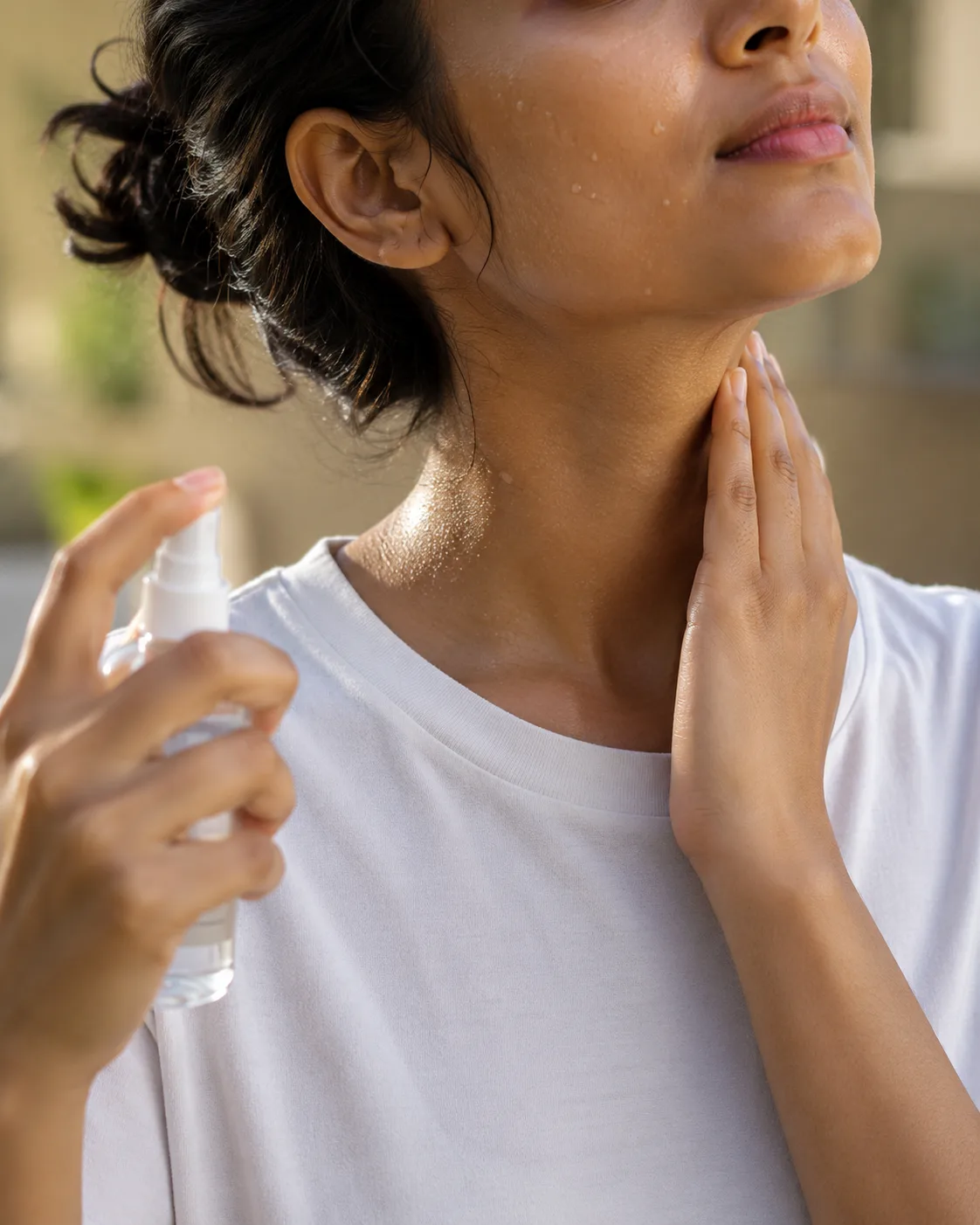
Sensible real-world uses. A gentle, low-sting HOCl mist or rinse can be a reasonable step after sweating, after a workout, or after a hot, dusty, high-pollution commute, and on reactive or compromised skin where you want something mild. It is well tolerated and stings far less than most actives (generally well tolerated, few adverse events).
Now the honest guardrails, this is the part most brands skip:
- HOCl does not remove PM2.5 pollution from your skin. Physically cleansing with water and a cleanser does that.
- HOCl is not a sunscreen and does nothing for UV or pigmentation. If dark spots are your concern, sunscreen and pigment-specific actives are the answer, not HOCl.
- HOCl is not a cleanser replacement.
- For everyday acne and barrier support, the human evidence is promising but still limited, much smaller than the decades of data behind gold-standard treatments like benzoyl peroxide (HOCl evidence is real but early; a measured take).
In short: HOCl is a useful, gentle add-on for the sweat-and-exposure part of your day. It is not the hero of your routine, and anyone telling you it is a miracle is overselling it.
Why Simpler Routines Often Win
There is a tempting logic that says: my environment is harsh, so I should throw more products at it. Usually the opposite is true.
When your barrier is already carrying a heavy daily load, piling on multiple serums, acids and exfoliants tends to cause more irritation, not less. Over-exfoliation, fragrance and active overload are some of the most common reasons stressed skin stays stressed. Less, done consistently, beats more done aggressively.
This is the thinking behind minimalist formulations, and it is why our own product is deliberately bare: Solvoe is just water, sodium chloride (salt), and hypochlorous acid, meant to be a gentle, optional step, not a routine overhaul. No fragrance, no actives stacked on top of your already-busy skin. (And if your routine is already working, you may not need it at all, that is a fine outcome too.)
 Tap to enlarge
How to Lower Your Skin's Environmental Load
A realistic, India-aware plan, in rough order of impact:
- Wear sunscreen every day. Highest-value step for pigment-prone skin. Broad-spectrum, reapplied through the day, all year, not just summer (why this matters most for Indian skin).
- Cleanse after heavy exposure. After a dusty, sweaty, high-pollution day, actually wash the day off, but do not over-wash, which strips the barrier.
- Do not over-exfoliate. A stressed barrier needs fewer actives, not more. Scale back if skin is stinging or flaking.
- Manage sweat. Change out of sweaty clothes and rinse after workouts. An HOCl mist is a reasonable optional step here.
- Be kind to hard-water skin. If you are reactive, use gentle, low-foaming cleansers and moisturise on damp skin. (Filters may help but evidence is limited, manage expectations.)
- Support the barrier daily. A ceramide moisturiser and pH-friendly products do real, measurable work (ceramides and barrier repair).
- Reduce friction. Clean your helmet padding and mask; use soft, moisture-wicking fabric where gear touches skin.
- Consider HOCl as an optional post-exposure step, with the honest limits above.
Frequently asked questions
Does pollution cause acne or make it worse?
Pollution does not single-handedly cause acne, but it makes things worse. Fine particles drive oxidative stress and inflammation, disturb the skin's pH and microbiome, and weaken the barrier, all of which can aggravate breakouts and dullness (pollution and skin mechanisms).
Why does Indian skin get dark spots so easily?
Because melanin-rich skin responds to UV and inflammation by producing pigment rather than just turning red. Combined with India's high year-round UV, that means tanning, dark spots and melasma form faster and last longer (pigmentation in Indian skin).
Is hard water bad for my skin?
It can be, especially if your skin is eczema-prone or reactive. Research links hard water to a weaker barrier and higher eczema risk, particularly in infants and people with a filaggrin gene variation (hard water and barrier function). For many adults the bigger issue is cleanser residue that does not rinse off cleanly.
Can humidity cause acne, and what is "fungal acne"?
Humidity creates a warm, sweaty, occluded environment where a normal skin yeast can overgrow, causing Malassezia folliculitis ("fungal acne"), itchy, uniform bumps that look like acne but need antifungal, not anti-acne, treatment (fungal acne).
What actually damages the skin barrier?
Over-washing, harsh or alkaline cleansers, over-exfoliation, fragrance on sensitive skin, plus environmental stressors like pollution, UV and hard water. The common thread is raised water loss and disturbed skin pH (barrier and pH).
Is hypochlorous acid safe for sensitive skin?
It is generally well tolerated and low-sting, and is used on broken and sensitive skin in wound care. Most people tolerate it well, but as with anything, patch test first (HOCl tolerability).
Can hypochlorous acid replace my cleanser?
No. HOCl can rinse and soothe, but it does not lift away oil, sunscreen, makeup or pollution particles the way a cleanser does. Use it as an optional extra step, not a swap.
Does hypochlorous acid help with pigmentation or dark spots?
There is no good evidence that HOCl fades pigment. For dark spots, the proven levers are sunscreen and pigment-specific actives, not HOCl.
Is hypochlorous acid safe during pregnancy?
HOCl is a non-cytotoxic molecule your body already makes, and FDA-cleared formulations are used topically in wound care (HOCl applications and clearance). There are not large pregnancy-specific trials, so the honest answer is likely fine topically, but check with your doctor, which is good practice for any product in pregnancy.
Before You Buy Any HOCl Product
One honest, often-skipped detail: hypochlorous acid is chemically unstable and degrades over time, converting into less-active chlorine compounds. Heat, light and air all speed this up (why HOCl loses potency). In practice that means HOCl products have a real shelf life, are best stored away from sunlight and heat, and lose strength some weeks after opening. If a brand cannot tell you how its HOCl is stabilised and stored, that is a fair question to ask, of us included.
The Bottom Line
If you take one thing from this: your skin is not fighting a single enemy, it is carrying a combined daily load, pollution, UV, heat, humidity, sweat, hard water and friction, and the goal is to lower that load and keep your barrier strong.
Worried about dark spots and tone? Sunscreen, every day, is your highest-value move.
Breaking out in humid months? Consider whether it is fungal acne, which needs different treatment.
Skin feels tight and reactive? Look at your cleanser, your water, and whether you are over-doing actives, then rebuild with a ceramide moisturiser.
Want a gentle post-sweat or post-pollution step? HOCl is a reasonable optional add-on, not a cleanser, sunscreen or cure.
See a dermatologist if your acne is severe, painful or scarring; if your acne is itchy and not improving with usual products (it may be fungal); if pigmentation is spreading or you want melasma treated properly; or if you have persistent redness, flaking or a barrier that will not settle.
Medical disclaimer: this article is general education, not personalised medical advice. Skin conditions vary, for diagnosis and treatment, see a qualified dermatologist.
Sources
- World Air Quality Report 2025, India summary. link
- IQAir, India air quality data. link · snapshot
- Air pollution and skin diseases: mechanisms (review). ScienceDirect. link
- PM2.5 damages skin cells by inducing oxidative stress. Archives of Toxicology. link
- Particulate matter and its molecular effects on skin. PMC. link
- The impact of pollution and climate change on skin health. JAAD Reviews. link
- Skin hyperpigmentation in the Indian population. Indian Journal of Dermatology / PMC. link
- Sunscreen efficacy on Indian skin types IV to V with pigmentation. IJDVL. link
- Fungal acne (Malassezia folliculitis). Cleveland Clinic. link
- Pityrosporum folliculitis. WebMD. link
- Malassezia-associated skin diseases. Frontiers in Cellular and Infection Microbiology. link
- Malassezia folliculitis: an underdiagnosed mimicker of acne. PMC. link
- Water hardness, atopic eczema and skin barrier function: systematic review and meta-analysis. Clinical & Experimental Allergy. link
- Domestic water quality, barrier function and eczema risk. BSACI. link
- Water hardness and the filaggrin gene in children. PubMed. link
- Hard water and atopic dermatitis. ECARF. link
- Acne mechanica caused by skin friction. Dermatology Times. link
- Acne from sports helmets and gear. U.S. Dermatology Partners. link
- Stratum corneum and epidermal barrier defects and repair. PMC. link
- TEWL and barrier function in atopic dermatitis. PMC. link
- The acid mantle and skin pH in dermatology. Journal of Integrative Dermatology. link
- Stratum corneum acidification and barrier restoration. Annals of Dermatology. link
- Ceramide formulations reduce TEWL and support the barrier (RCT). PMC. link
- Hypochlorous acid: applications in dermatology (review). Journal of Integrative Dermatology. link
- HOCl is antipruritic and anti-inflammatory in a mouse model of atopic dermatitis. Clinical & Experimental Allergy. link
- Status report on topical hypochlorous acid. Journal of Clinical and Aesthetic Dermatology. link
- Hypochlorous acid in skincare, does it work? Scientific American. link
- Will hypochlorous acid mists help my skin? Banner Health. link
- Hypochlorous acid stability and shelf life (plain-language). Chemist Confessions. link
Keep reading
More honest, evidence-first guides from Solvoe.
Best Hypochlorous Acid Spray in India: How to Choose
No single best spray, just real HOCl versus salt water with a story. The five specs that tell them apart.
Read the guide
Azelaic Acid vs Hypochlorous Acid: Which Is Better?
Not really rivals. Which wins for acne, redness and dark spots, and how to use both.
Read the guide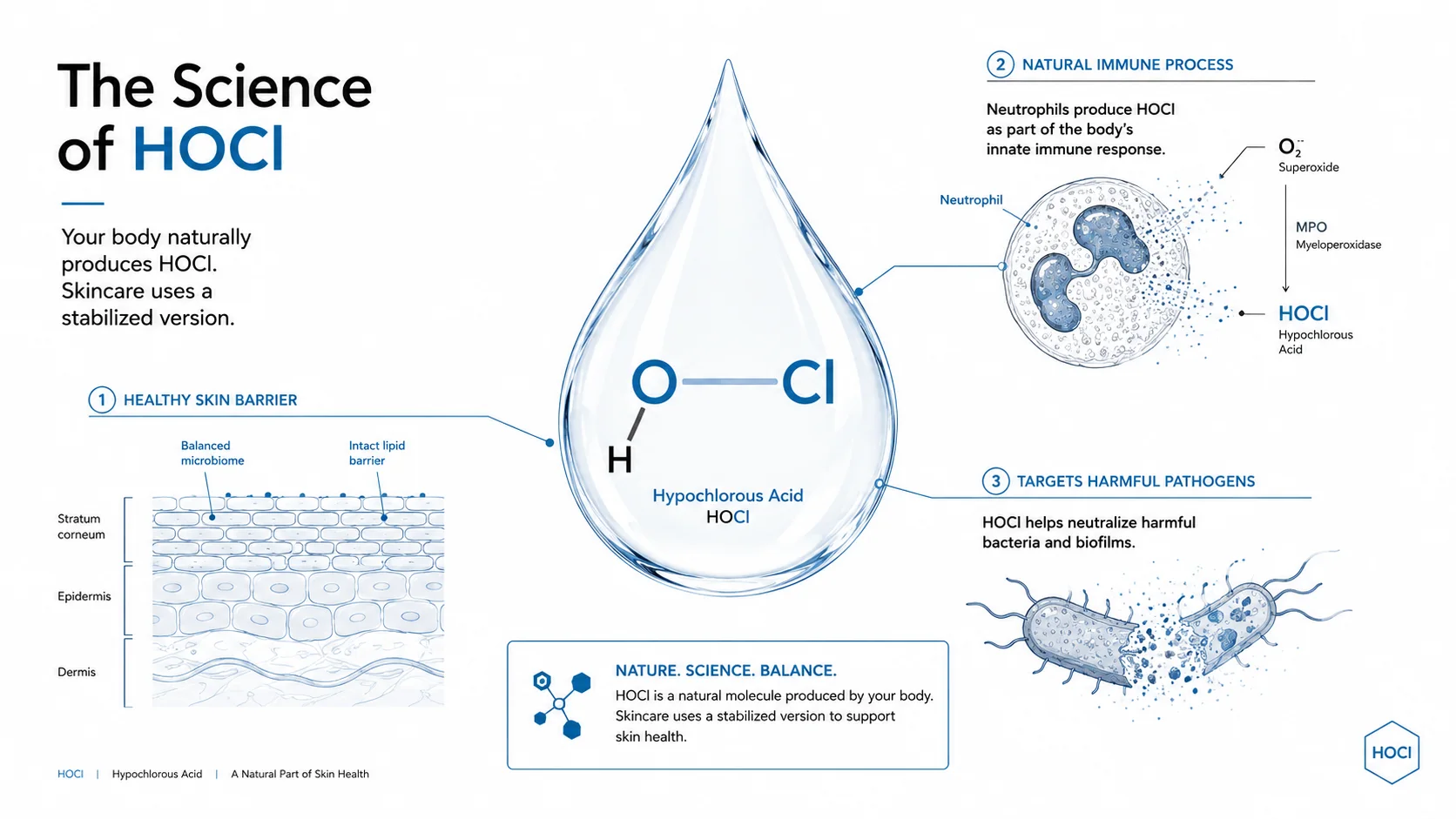
What Is Hypochlorous Acid (HOCl)?
What the dermatology evidence actually supports, where it is weak, and who should bother.
Read the guide