Azelaic Acid vs Hypochlorous Acid: Which Is Better for Acne, Redness, and Dark Spots?
They are not really rivals, they do different jobs. Azelaic acid treats acne, redness and dark spots; hypochlorous acid soothes and keeps skin clean. Here is exactly when to use each, and how to use both.

Quick answer (TL;DR): These two ingredients are not really rivals, they do different jobs. Azelaic acid is a proven, do-it-all treatment ingredient that can improve acne, redness and dark spots. Hypochlorous acid is a gentle, soothing mist that calms irritation and helps keep skin clean, but it does not fade pigment and has far less research behind it. For most people chasing real results on breakouts, rosacea or spots, azelaic acid is the workhorse, and hypochlorous acid can be a low-risk add-on. Below is exactly when to reach for each, and how to use both together.
On this page
- Why "vs" is the wrong question
- What is azelaic acid?
- What is hypochlorous acid?
- How each one works
- Head-to-head: acne, redness, dark spots
- Strengths, forms and where to find them
- How to actually use them
- Using both in one routine
- Side effects and safety
- How long until you see results
- Myths and FAQs
- What we've seen with users
- Quick decision guide
- The verdict
- Sources
Why "vs" is the wrong way to think about it
A lot of articles try to crown a winner. That is misleading, because azelaic acid and hypochlorous acid sit in completely different categories.
- Azelaic acid is an active treatment. It has FDA-approved prescription forms, a 20% cream for acne and a 15% gel or foam for rosacea, and decades of clinical trials behind it.
- Hypochlorous acid (HOCl) is a gentle antimicrobial spray. It is best known and FDA-cleared for wound care and as a soothing skin solution, not as an approved acne or dark-spot treatment.
So the useful question is not "which one wins?" It is "which one for which job, and can I use both?" That is what the rest of this guide answers.
 Tap to enlarge
What is azelaic acid?
Azelaic acid is a naturally occurring acid found in grains like wheat, rye and barley, and it is also produced by a yeast that lives on your skin. In skincare and prescriptions it is used at higher concentrations to do several things at once. Researchers describe it as having antibacterial, anti-inflammatory, pore-normalizing and pigment-fading effects.
In plain terms, azelaic acid is a multitasker: it can calm breakouts, settle redness and even out tone, which is rare for a single ingredient.
What is hypochlorous acid?
Here is the surprising part: hypochlorous acid is something your own body already makes. When your white blood cells detect bacteria, they produce HOCl as part of your immune defense. In skincare it is recreated as a very dilute, stabilized spray, often around 0.01% (roughly 100 to 200 parts per million), though products vary.
It is prized for being extremely gentle, so gentle it is used after surgery, on wounds and for eyelid hygiene. On the face it is mostly used as a calming, reset mist for sensitive, reactive or post-workout skin.
How each one works (in simple terms)
Azelaic acid
The active treatment
- Fights acne bacteria (C. acnes) and helps keep pores from clogging.
- Calms inflammation by quieting an overactive skin pathway involved in rosacea.
- Fades dark spots by blocking tyrosinase, the enzyme that makes melanin, while leaving your normal tone alone, which is why it does not lighten healthy surrounding skin.
Hypochlorous acid
The gentle supporter
- Cleans without harshness by physically disrupting microbes, and because it works mechanically it does not drive antibiotic resistance.
- Soothes by dialing down inflammatory signals, which can reduce itch and redness.
The honest difference: azelaic acid is backed by large reviews and randomized trials. Hypochlorous acid's skincare evidence is thinner, mostly small studies plus its strong track record in wound care.
 Tap to enlarge
Head-to-head: which is better for...
...acne?
Winner: azelaic acid (for treating it). In a head-to-head trial, azelaic acid 15% gel was found as effective as (noninferior to) the retinoid adapalene 0.1%, with significantly less dryness and flaking. It tackles both clogged pores and inflamed pimples.
Hypochlorous acid is more of a maybe. The most-cited study is a small, older trial where a hypochlorous-based solution performed about the same as benzoyl peroxide and beat placebo, promising, but underpowered and not enough to call it a true acne treatment.
Bottom line: use azelaic acid to treat acne. Use hypochlorous acid as a gentle mist to keep skin calm and clean between treatments.
...redness and rosacea?
Winner: azelaic acid (for the condition); hypochlorous acid (for day-to-day soothing). Azelaic acid 15% is FDA-approved for the bumps-and-redness type of rosacea, and in reviews it outperformed a common prescription alternative (metronidazole 0.75%) on redness and lesion counts.
Hypochlorous acid feels good on flushed, reactive skin and is exceptionally well tolerated, but the evidence for rosacea is mostly observational, not from large trials.
Bottom line: azelaic acid treats rosacea. Hypochlorous acid is a low-risk way to calm flare-ups and reactivity between treatments.
...dark spots and hyperpigmentation?
Winner: azelaic acid, and it is not close. Azelaic acid blocks the enzyme that makes pigment, which is why it is a recognized option for melasma and post-acne dark marks.
Hypochlorous acid does essentially nothing for dark spots, it has no effect on melanin. If fading pigment is your goal, HOCl is not the tool.
Dark spots vs acne scars, an important difference
People often lump these together, but they are not the same, and it changes what will help:
- Brown marks (post-inflammatory hyperpigmentation): flat dark spots left after a pimple heals. Azelaic acid can help fade these.
- Red or pink marks (post-inflammatory erythema): flat red or purple marks, more common on lighter skin. These usually fade on their own; azelaic acid's calming effect may help a little, HOCl will not meaningfully change them.
- True scars (rolling, boxcar, icepick or raised): these are changes in skin texture, not color. Neither azelaic acid nor HOCl fixes them, that is the territory of procedures like microneedling, lasers or fillers. Do not let any product promise otherwise.
 Tap to enlarge
Strengths, forms and where to find them
Azelaic acid comes in two tiers:
- Over the counter (about 10 to 14%): good for mild acne, early uneven tone and sensitive skin that wants to ease in. Common in serums and creams.
- Prescription (15 to 20%): FDA-approved strengths for more stubborn acne, rosacea and pigment. Worth asking a dermatologist about if OTC is not enough.
Hypochlorous acid comes almost exclusively as a spray or mist. One thing most articles skip: HOCl is unstable. It breaks down with light, heat and time, so buy from brands that use opaque packaging, check freshness, and do not expect a years-old bottle to still be active.
How to actually use them
Azelaic acid:
- Apply a thin layer to clean, dry skin, once or twice daily.
- Follow with moisturizer, and always use SPF 30+ in the morning.
- Sensitive skin? Start every other day and build up.
Hypochlorous acid:
- Spray anytime, after cleansing, after the gym, after a procedure, or to calm a flare. Let it dry before your other products.
A quick word on layering azelaic acid with other actives (vitamin C, niacinamide, retinoids, benzoyl peroxide): it is usually fine, but stacking too many irritating actives at once can backfire. Introduce one new active at a time.
Can you use hypochlorous acid and azelaic acid in the same routine?
Yes, and they actually pair well, because one soothes and the other treats. The simplest approach is HOCl as a calming mist and azelaic acid as your treatment step. Here is what that looks like:
Morning. 1) Gentle cleanser. 2) Hypochlorous acid mist (let it dry). 3) Azelaic acid (optional in the AM if your skin tolerates it). 4) Moisturizer. 5) Sunscreen (SPF 30+), non-negotiable, especially when fading dark spots.
Evening. 1) Gentle cleanser. 2) Hypochlorous acid mist (let it dry). 3) Azelaic acid. 4) Moisturizer.
 Tap to enlarge
If your skin is sensitive or new to azelaic acid, start it 2 to 3 nights a week and build up. The HOCl mist can also be used on its own anytime, after the gym, after a flare, or after an in-office treatment.
Side effects and safety
Azelaic acid is generally well tolerated. The most common side effects are temporary stinging, burning, tingling or dryness when you first start. Keep it away from your eyes.
Hypochlorous acid is one of the gentlest things you can put on your face. The main risk is over-relying on it as a treatment when it is really a supportive step.
Azelaic acid is often considered one of the safer acne options during pregnancy because very little is absorbed through the skin. The honest caveat: there are no large human trials in pregnancy, and animal studies showed effects only at high oral (eaten) doses, not topical use, so always clear it with your own doctor first. Hypochlorous acid's gentle profile makes it an easy, low-worry option too.
A note for deeper skin tones: if you are prone to post-inflammatory hyperpigmentation (dark marks left behind after a pimple), azelaic acid is especially worth knowing about, since it targets both the breakout and the mark. Honest caveat: the FDA label notes isolated reports of hypopigmentation (lightened patches), and it has not been heavily studied on very dark skin, so start slow, patch test, and stop if you notice uneven lightening.
How long until you see results?
Set realistic expectations, no active works overnight.
- Azelaic acid: early acne improvement around 4 weeks, rosacea around 12 weeks, and dark spots typically 12 to 24 weeks of consistent use.
- Hypochlorous acid: an instant soothing, fresh feel, but it is comfort, not a structural fix.
Myths and FAQs
Does hypochlorous acid fade dark spots?
No. It has no effect on pigment. If fading dark spots is your goal, azelaic acid (or another tyrosinase-blocking active) is the tool, not HOCl.
Is hypochlorous acid just bleach?
No, this is the most common myth. Household bleach is sodium hypochlorite at high, irritating concentrations. Skincare HOCl is a different, far milder form your own immune cells produce, used at tiny concentrations (often around 0.01%, roughly 100 to 200 ppm). It is gentle enough for wound care and sensitive skin.
Can hypochlorous acid replace my acne treatment?
No. Think of it as a gentle supporting player, not the star. Use a proven active like azelaic acid to treat acne, and HOCl to keep skin calm and clean between treatments.
Is azelaic acid or hypochlorous acid better for sensitive skin?
Both are gentle. HOCl is the most soothing; azelaic acid is gentle for an active treatment and is often recommended when stronger actives are too harsh.
Will azelaic acid bleach my skin or towels?
It evens out excess pigment without lightening normal skin, and it does not bleach fabrics like benzoyl peroxide can.
Can I use hypochlorous acid every day?
Yes, it is safe for daily, even multiple-times-a-day, use.
Azelaic acid vs niacinamide or vitamin C for dark spots?
All three help with tone. Azelaic acid is a strong, well-studied choice and is often combined with the others; the best pick depends on your skin and what you already use.
Which is better for hormonal acne?
Neither is a hormonal treatment, but azelaic acid can still help by calming inflammation and clearing pores. Hormonal acne (deep, jawline, cycle-timed breakouts) often also needs internal treatment, worth a dermatologist visit.
Are there risks with long-term use?
Both have good long-term safety records. Azelaic acid may keep causing mild tingling for some people but is not known to thin skin or cause rebound. Hypochlorous acid is very low-risk long term; just remember it is a supportive mist, not a standalone treatment.
What we've seen working with hypochlorous acid users
As a hypochlorous acid brand, the pattern we keep coming back to is simple: people get the best results when they stop asking HOCl to do a treatment's job. The most useful framing we can offer is the one this whole guide is built on. Let hypochlorous acid do the gentle, everyday work, soothing, calming and keeping skin clean, and let a proven active like azelaic acid do the treating. Used that way, as partners rather than substitutes, expectations match reality and people actually stick with the routine. Two questions are worth settling before you buy anything: what are you trying to treat, and what are you trying to soothe? Answer those honestly and the choice below makes itself.
Quick decision guide: which should you choose?
 Tap to enlarge
The verdict
Treating acne, rosacea or dark spots: azelaic acid.
Soothing, calming, sensitive-skin maintenance: hypochlorous acid.
Dark spots specifically: azelaic acid, no contest.
Best of both: use HOCl to calm and azelaic acid to treat.
See a dermatologist if your acne is severe or cystic, you have diagnosed rosacea or melasma, or you do not see improvement after about 4 weeks (acne) to 12 weeks (rosacea).
This article is for general education and is not a substitute for personalized medical advice. Talk to a qualified healthcare provider about your skin.
Sources
- King M. A systematic review to evaluate the efficacy of azelaic acid in acne, rosacea, melasma and skin aging. Journal of Cosmetic Dermatology, 2023. link
- Azelaic Acid: Mechanisms of Action and Clinical Applications. 2024. PubMed · Dovepress
- Sauer N, et al. The multiple uses of azelaic acid in dermatology. 2023. PMC
- A Comprehensive Review of Azelaic Acid Pharmacological Properties and Topical Formulations. 2025. MDPI
- Searle T, Ali FR, Al-Niaimi F. The versatility of azelaic acid in dermatology. Journal of Dermatological Treatment, 2020. link
- Thielitz A, et al. Azelaic acid 15% gel vs adapalene 0.1% gel in adult female acne (randomized trial). JEADV, 2015. PubMed
- U.S. FDA. AZELEX (azelaic acid cream) 20%, prescribing information. FDA label
- Natarelli N, et al. Hypochlorous Acid: Applications in Dermatology. Journal of Integrative Dermatology, 2022. link
- Hypochlorous Acid: Clinical Insights and Experience Across Specialties. Biomedicines, 2025. MDPI
- Tirado-Sanchez A, Ponce-Olivera RM. Efficacy and tolerance of superoxidized solution in mild to moderate inflammatory acne (RCT). J Dermatolog Treat, 2009. link
- Social Media Mythbusters: Hypochlorous Acid Sprays. Dermatology Times, 2025. link
- Mayo Clinic. Azelaic acid (topical route). link
- Drugs.com. Azelaic acid topical use during pregnancy. link
- Azelaic Acid Strengths and Forms. RedBox Rx
Keep reading
More honest, evidence-first guides from Solvoe.
Best Hypochlorous Acid Spray in India: How to Choose
No single best spray, just real HOCl versus salt water with a story. The five specs that tell them apart.
Read the guide
Why Indian Skin Faces More Environmental Stress Than Ever
Pollution, UV, heat, hard water and friction hit at once. What that does to your barrier, and how to lower the load.
Read the guide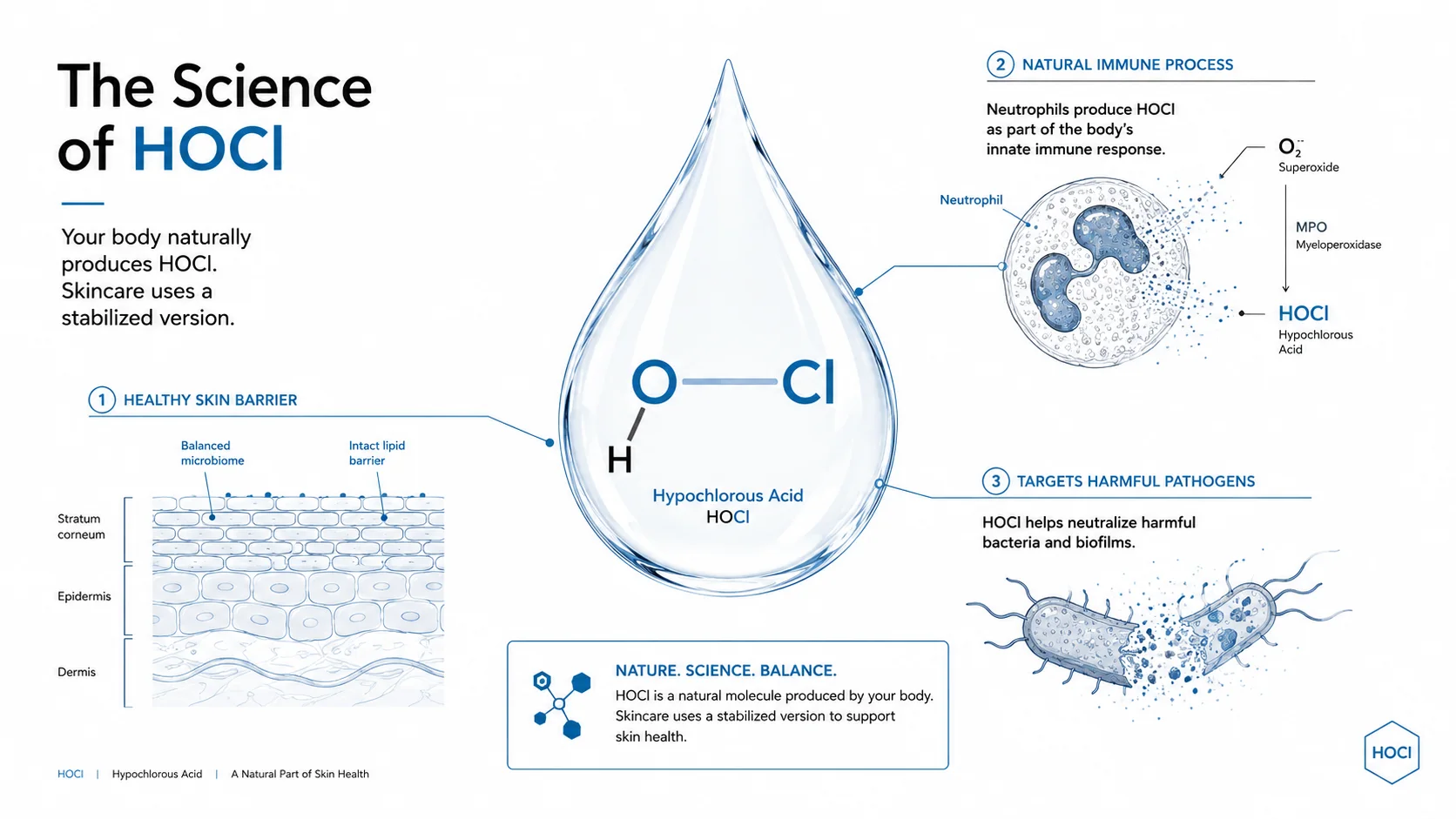
What Is Hypochlorous Acid (HOCl)?
What the dermatology evidence actually supports, where it is weak, and who should bother.
Read the guide