Best Hypochlorous Acid Spray in India: How to Choose (and Spot Salt Water)
There is no single best HOCl spray, only real hypochlorous acid versus salt water with a story. The five specs that tell them apart, and how India's brands measure up.
There is no single best hypochlorous acid spray in India, and any list that crowns one number one is usually trying to sell you that one. What actually matters is whether a bottle is real HOCl or, as we like to put it, salt water with a story: saline that has lost most or all of its active hypochlorous acid. Two sprays can look identical, cost the same, and one can be a genuinely useful antimicrobial mist while the other does almost nothing.
So this is not a ranking. It is a buyer's checklist. Five specs tell you almost everything, and you can read all of them off the label and the brand's own page, no lab required. Learn to read those five and you can score any bottle yourself, including ours.

On this page
- Quick answer
- Why most "best spray" lists are useless
- What HOCl actually is (30 seconds)
- The checklist: real or fake?
- 1. A stated concentration (ppm)
- 2. A stated pH of about 4 to 5
- 3. Opaque packaging, fine mist
- 4. A real date
- 5. A short ingredient list
- 6. The nose check (secondary)
- Score any bottle in 60 seconds
- Is my spray legit? A gut-check
- India spec check
- A note on Solvoe RESET
- FAQ
- The verdict
- Sources
Quick answer
There is no single best hypochlorous acid (HOCl) spray in India. What matters is whether a bottle is real HOCl or salt water with a story. Five specs tell you almost everything: a stated concentration in ppm (skincare formulas usually sit around 50 to 200 ppm, and more is not better), a stated pH of about 4 to 5 (where HOCl is the active form), opaque light-blocking packaging with a fine mist, a manufacture or expiry date, and a short ingredient list (essentially water, salt and hypochlorous acid, with fragrance a red flag). Score any bottle against those five and buy the one that passes.
Why most "best HOCl spray" lists are useless
Search "best hypochlorous acid spray" and you will get ranked lists where the number one pick is, conveniently, whatever the site is paid to sell. That is a problem on a skincare ingredient where the bottle barely tells you anything. Two sprays can look identical, cost the same, and one can be a real antimicrobial mist while the other is close to salt water with a story.
So we will walk through the five things that separate a real HOCl product from a fake one, give you a one-line takeaway for each, and show you how real India-available brands measure up where we could verify their specs. At the end there is a simple scorecard so you can grade any bottle, and one honestly labelled box about our own product, Solvoe RESET, held to the exact same standard. The rule we keep coming back to: judge the bottle by its numbers, not by the word natural on the front.
First, what hypochlorous acid actually is (30 seconds)
Hypochlorous acid is the same molecule your own immune cells make to fight microbes, which is part of why it is so well tolerated on skin. In medicine it has a long track record in wound care and eyelid hygiene, and dermatology reviews describe it as antimicrobial, anti-inflammatory and gentle enough for sensitive and acne-prone skin (Journal of Integrative Dermatology review; Biomedicines, 2025 review).
Two honest caveats we cover in detail in our main hypochlorous acid guide. The strongest evidence is for wound care and eyelid conditions; the everyday-skincare evidence (acne, redness, barrier support) is promising but smaller than the evidence behind standard treatments.
And HOCl is fragile, which is the whole reason the specs below matter. A poorly made or badly packaged HOCl spray can degrade into not much at all.
The checklist: how to tell if a hypochlorous acid spray is real
Here is the whole checklist in one view. Each item gets its own section below, but this is what you are looking for.
- 1
Stated concentration (ppm)
Around 50 to 200 ppm for facial skincare, and more is not better.
- 2
A pH of about 4 to 5
The weakly acidic window where HOCl is the active form.
- 3
Opaque bottle, fine mist
Light and air degrade HOCl, so packaging protects it.
- 4
A real date
HOCl expires, so a trustworthy bottle is dated.
- 5
A short ingredient list
Essentially water, salt and HOCl. Fragrance is a red flag.
- 6
The nose check (secondary)
A faint clean pool note, never perfume. A tiebreaker, not proof.
1. Does it state a concentration (ppm)? And remember, more is not better
One-line takeaway: A real HOCl spray tells you its strength in ppm; for facial skincare that is usually somewhere around 50 to 200 ppm, and a higher number is not a better product.
Hypochlorous acid for skin is sold in a fairly low concentration. Skincare and wound-care HOCl solutions commonly sit in roughly the 50 to 200 ppm band (often around 50 to 100 ppm for everyday facial use), which is enough to be antimicrobial while staying gentle (Aqualution science overview; Journal of Integrative Dermatology review).
Here is the part marketing gets wrong: a bigger ppm number is not a better skincare product. Pushing the concentration up mainly raises the risk of irritation without buying you a meaningfully better mist for daily use (dermatologist commentary via NBC Select).
It is worth being precise about why, because a popular online claim, that stronger HOCl burns your healing cells, overstates things. Across commercial hypochlorite and HOCl solutions, stronger antimicrobial activity did track with lower skin-cell viability, and both rose with concentration and contact time (Severing et al., J Antimicrob Chemother, 2019).
But in head-to-head skin-cell testing, sodium hypochlorite and HOCl was the least damaging of the common clinical antiseptics tested, gentler than the alternatives (Ortega-Llamas et al., Cells, 2022).
The honest takeaway: a well-formulated HOCl mist is gentle, but pushing concentration up buys irritation risk, not benefit. Stronger is a marketing flex, not a skincare upgrade.
What to look for: a clearly stated ppm on the label or product page. Red flag: no concentration stated anywhere, or marketing that brags about being the strongest.
How a real brand does it: Minimalist's HOCl Skin Relief Spray states 150 ppm right in the product name and on its ingredient breakdown (INCIDecoder; brand page). Whatever you think of any single brand, stating the number is the behaviour you want to reward.
2. Is the pH stated, and is it about 4 to 5?
One-line takeaway: HOCl is only the active molecule in a weakly acidic window; look for a stated pH around 4 to 5.
This is the spec almost nobody talks about, and it matters enormously. Hypochlorous acid in water can exist as two different things depending on pH: the active HOCl, or the far weaker hypochlorite ion.
Around pH 4 to 5, essentially all of it is the active HOCl form. As the pH climbs toward neutral, more of it converts to the weaker ion, and HOCl is many times more effective as an antimicrobial than hypochlorite (Wang et al., J Burns Wounds, 2007; HOCl vs hypochlorite, Journal of Global Health Reports).
Dermatology reviews make the same point about real products: how a topical HOCl behaves on skin depends heavily on pH and formulation stability, not just on what the front of the bottle claims (Del Rosso & Bhatia, J Clin Aesthet Dermatol, 2018).
In plain terms: a hypochlorous acid spray sitting at the wrong pH may be mostly the wrong, weaker molecule, even if it was made correctly.
What to look for: a stated pH, ideally around 4 to 5 (some products list a slightly wider window). Red flag: no pH stated at all.
How a real brand does it: Minimalist lists a pH of 4.0 to 5.0 on its HOCl spray (INCIDecoder). That is exactly the kind of disclosure that lets you trust the active claim.
3. Is it in opaque, light-blocking packaging with a fine mist?
One-line takeaway: HOCl breaks down in light and air, so a real product comes in an opaque or coated bottle with a proper fine-mist sprayer; a clear bottle on a bright shelf is a warning sign.
Hypochlorous acid is genuinely fragile. Light (especially UV) and exposure to air both degrade it over time, which is why stabilised HOCl products are typically stored in opaque, airtight containers kept cool and dark (hypochlorous acid storage overview).
A fine-mist spray also limits how much air gets into the bottle with each use, compared with an open splash bottle. This is where salt water with a story often hides: a beautiful clear bottle photographs well and dies fast.
What to look for: an opaque, amber, or coated bottle; a true fine-mist nozzle; storage instructions that mention keeping it cool and out of sunlight. Red flag: a clear bottle with no light protection, or no storage guidance at all.
One honest note on this criterion: bottle opacity is the one spec you usually cannot confirm from an online listing, because product photos are styled and rarely show the real material. Check it in person where you can, and treat a clearly transparent bottle as a genuine mark against a product even if its numbers look good.
4. Does it carry a manufacture or expiry date, and a realistic shelf life?
One-line takeaway: Because HOCl degrades, a trustworthy bottle shows a manufacture or expiry date; lasts forever is not a feature, it is a tell.
Following directly from the point above: a product that loses potency over time must be dated. Stabilised commercial HOCl is often given a sealed shelf life of 12 to 24 months when stored properly, and potency drops faster once the bottle is opened and exposed to air and light (shelf-life and storage overview).
Exact figures vary a lot by formulation and packaging, so treat any single number as approximate.
What to look for: a manufacture date and an expiry or best-before date, plus a sensible use within X months of opening. Red flag: no date anywhere, or claims of an implausibly long, stability-defying shelf life. As one data point, The Derma Co publishes a 24-month best-before from manufacture on its HOCl spray (brand page), which is the kind of disclosure to look for.
5. Is the ingredient list short, basically water, salt, and hypochlorous acid?
One-line takeaway: Real HOCl is almost nothing else: water, sodium chloride (salt), and hypochlorous acid. A long list, especially with fragrance, is a red flag.
Genuine hypochlorous acid solution is made from salt and water, so the ingredient list should be very short.
Added fragrance is the one to watch. Fragrance is one of the most common causes of allergic contact dermatitis on the face and neck, which is the opposite of what a soothing mist should be doing (DermNet: fragrance allergy; Dermatology Times). Extra actives, dyes and essential oils similarly add irritation risk and, in some cases, can interfere with the chemistry.
One fairness note that matters: not minimal is not the same as fake. Many India-available sprays are genuinely fragrance-free but add humectants or extra actives (glycerin, allantoin, hyaluronic acid, amino acids, zinc, rose water).
Those additions are not red flags the way fragrance is; they just mean the bottle is an HOCl-plus hybrid rather than the bare water-salt-HOCl formula. Judge each on the whole checklist, not one column.
What to look for: an ingredient list that is essentially water, salt and hypochlorous acid, explicitly fragrance-free. Red flag: added fragrance or parfum, essential oils, dyes, or a long mixed-actives list.
How a real brand does it: Minimalist's spray lists just water, sodium chloride and hypochlorous acid, and is labelled free of fragrance, silicones, parabens, sulphates, dyes and essential oils (INCIDecoder ingredient list). That is the short, boring list you want.
6. The nose check: does it smell like a faint clean pool, and nothing like perfume?
One-line takeaway: A real HOCl mist usually has a faint, clean chlorine or pool-like scent that fades fast; a perfumed smell is a red flag. Treat this as a secondary gut-check, not a replacement for the ppm and pH on the label.
A light just-cleaned-pool note is normal and actually reassuring. It means free chlorine is present, and the scent comes partly from HOCl reacting with organic matter as it works (what HOCl smells like, MEDI+KURIN).
But be careful how much you read into it, because smell cannot measure potency. A faint scent is a good sign; a sharp, lingering bleach reek can point to a harsher or less stable formula; a perfumed scent means fragrance has been added, exactly what criterion 5 warns against.
And no smell at all is ambiguous: it could be a very low concentration, or a bottle that has already degraded.
What to look for: a faint, clean chlorine note that disappears quickly. Red flag: any added perfume or fresh floral scent, or a harsh persistent bleach smell. A caveat worth keeping honest: your nose is a tiebreaker, not evidence. The numbers on the label are what actually confirm real HOCl.
Score any bottle in 60 seconds
Score each of the five core checks 0, 1, or 2 (0 = missing, 1 = partial, 2 = clearly meets it). That is a 10-point scale. Smell is a secondary tiebreaker worth one bonus point.
Tap a score for each check below. The total updates as you go.
No data leaves your device. This is a quick self-scoring guide, not a lab result.
8 to 10: a product taking HOCl chemistry seriously.
5 to 7: may be fine, but is missing basics you would want disclosed.
0 to 4: too many gaps to trust what is inside.
Miss on pH or ppm and you cannot verify it is active HOCl at all; miss on packaging or date and even good HOCl may not survive to your skin; miss on ingredients, especially fragrance, and you are paying for irritation risk you did not need. Smell only breaks ties; never let a nice clean scent override missing numbers.
Is my hypochlorous acid spray legit? A quick gut-check
If you have already bought one, run it through these fast questions. None of this needs a lab; it is all on the packaging, if the brand respects you enough to print it.
- Can you find its ppm and pH on the bottle or the brand's site? If neither exists, you cannot confirm it is active HOCl.
- What does the bottle look like? Clear glass on a bright shelf is working against the chemistry; opaque and misted is working with it.
- Is there a date on it, and how long has it been open? HOCl quietly loses strength with light, air and time, so an old half-used clear bottle is probably weaker than the label suggests.
- What does it smell like? A faint clean-pool note is fine and expected; a perfumed scent means fragrance was added; no smell at all is a question mark. Secondary signal only.
Quick spec check: hypochlorous acid sprays available in India
Here is where the checklist meets the real market. Below are HOCl sprays sold in India, with only the specs we could verify from each brand's own listing or an ingredient database.
Where a number is not published, the cell says Not disclosed rather than guessing. That blank is itself useful information, because not disclosing your ppm or pH is exactly the gap criteria 1 and 2 are about.
Specs and formulas change, so confirm any cell against the live label before you buy.
| Brand | Size | HOCl concentration | pH | Formula type | Key ingredients / actives | Shelf life |
|---|---|---|---|---|---|---|
| Minimalist HOCl Skin Relief | 200 ml | 150 ppm | 4.0 to 5.0about 4.7 | Minimal | Water, sodium chloride, hypochlorous acidSource: INCIDecoder | 12 months |
| Dr. Algar HOCl Face & Body Spray | 200 ml | Not publicly verified | Not publicly verified | Non-minimal | Hypochlorous acid, urea, multi hyaluronic acidSource: Amazon.in | 24 months |
| The Derma Co Hypochlorous Anti-Acne Spray | 200 ml | 200 ppm | Not disclosed | Non-minimal | Water, glycerin, sodium chloride, allantoin, phenoxyethanol, ethylhexylglycerin, hypochlorous acidSource: brand site | 24 months |
| Skinvest MVP | 100 ml | 150 ppm | pH-balancedexact value not disclosed | Non-minimal | Water, Pentavitin, zinc PCA, sodium hydroxide, hypochlorous acidSource: brand site | 24 months |
| Conscious Chemist HOCl Daily Spray | 100 ml | Not disclosed | Not disclosed | Non-minimal | Multi hyaluronic acids, urea, amino acids, sodium PCA, butylene glycol, hypochlorous acidSource: brand site | 12 months |
| Solved Labs SOS | 50 ml | 0.02% HOClabout 200 ppm | Not disclosed | Non-minimal | Hyaluronic acid, biosaccharides, urea, trehalose, serine, humectant complex, hypochlorous acidSource: INCIDecoder | 12 months |
| Mighty Theory Skin Defense Mist | 100 ml | 150 ppm | Not disclosed | Non-minimal | Hypochlorous acid, cica, peptide complex | 24 months |
| Rivona Naturals Genie | 50 ml | Not disclosed | Not disclosed | Non-minimal | Hypochlorous acid, niacinamide, alpha arbutin, hydragen aquaporinSource: brand site | 36 months |
| Solvoe RESET | 100 ml | 200 ppm | 4.0 to 5.0 | Ultra-minimal | Aqua, hypochlorous acid | 12 months |
Swipe sideways to see every column.
This is not a ranking, and the blanks are deliberate. Minimalist, The Derma Co, Skinvest, Solved Labs and Mighty Theory publish a concentration; only Minimalist states both ppm and pH clearly. Most brands still disclose neither.
None of the listed sprays contained added fragrance, but most are HOCl-plus hybrids rather than minimal, RESET included in its ultra-minimal, two-ingredient form. Bottle opacity could not be verified for any of them from text listings; that needs a physical pack check (see criterion 3).
Imported brands are also sold in India; judge them on the same five specs.
Formula simplicity ranking
Ranked from fewest to most added ingredients, using each brand's published or listed formula.
| Rank | Brand | Formula complexity |
|---|---|---|
| 1 | Solvoe RESET | Ultra-minimal, 2 ingredients |
| 2 | Minimalist | Minimal, 3 ingredients |
| 3 | Skinvest MVP | Simple, plus zinc PCA and Pentavitin |
| 4 | The Derma Co | HOCl plus hydration actives and preservatives |
| 5 | Dr. Algar | HOCl plus urea and multi hyaluronic acid |
| 6 | Mighty Theory | HOCl plus cica and peptides |
| 7 | Conscious Chemist | Multi-hyaluronic and amino acid complex |
| 8 | Solved Labs SOS | Large humectant and conditioning complex |
| 9 | Rivona Naturals Genie | HOCl plus brightening actives (niacinamide, alpha arbutin) |
A note on our own product, Solvoe RESET
We are Solvoe, and we built RESET to the exact five standards above, which is the whole reason we are comfortable handing you the checklist instead of a sales pitch. We designed it for a stated skincare-range concentration, a pH in the active 4 to 5 window, light-blocking packaging with a fine mist, a printed date, and a minimal fragrance-free formula. Hold us to every box on the scorecard; if a competitor's bottle passes all five and you can buy it today, that is a reasonable choice.
Where we're still building trust: RESET is new. We are not yet stocked on Amazon or Nykaa, and an established brand with years of reviews behind it has a real, practical advantage over us. If you need an HOCl spray this week and want that track record, use the checklist above to choose one that passes. If you would like to try ours, it's available direct from us.
Questions people ask most
What ppm should a hypochlorous acid spray be?
For facial skincare, hypochlorous acid is usually in roughly the 50 to 200 ppm range (often around 50 to 100 ppm for everyday use), enough to be antimicrobial while staying gentle. A higher ppm is not a better skincare product; it mainly raises irritation risk.
How can I tell if hypochlorous acid is real or just salt water?
Check five things: a stated ppm, a stated pH around 4 to 5, opaque packaging with a fine mist, a manufacture or expiry date, and a short, fragrance-free ingredient list (water, salt, HOCl). A bottle that hides its ppm and pH, sits in clear glass, and carries no date is the profile of salt water with a story.
What pH should hypochlorous acid be?
About 4 to 5. In that weakly acidic window almost all of it is the active HOCl molecule; closer to neutral pH, more converts to the much weaker hypochlorite ion.
Does hypochlorous acid spray expire?
Yes. It degrades with light, air and time, so it should carry a date. Stabilised products often list a 12 to 24 month sealed shelf life when stored cool and dark, with faster potency loss after opening. Never expires is a warning sign, not a feature.
Can a hypochlorous acid spray be too strong?
For daily skincare, chasing a very high ppm mainly adds irritation risk rather than benefit. Notably, pure HOCl itself stayed gentle on skin cells even at several times the usual strength in lab studies, gentler than antiseptics like povidone iodine or chlorhexidine, so the issue with stronger formulas is irritation and marketing, not that HOCl burns healing cells.
Should a hypochlorous acid spray contain fragrance?
No. Genuine HOCl is essentially water, salt and hypochlorous acid. Fragrance is one of the most common causes of facial allergic contact dermatitis, so it works against the soothing purpose of the mist.
What should hypochlorous acid smell like?
Usually a faint, clean chlorine or just-cleaned-pool scent that fades quickly, a sign free chlorine is present and reacting. Smell cannot measure strength, though, so treat it as a quick sanity check, not proof. A perfumed scent means fragrance was added (a red flag); a harsh, lingering bleach smell can signal a harsher formula; and no smell at all is ambiguous.
The verdict
There is no universal best hypochlorous acid spray in India. There is only real, well-made HOCl versus salt water with a story, and now you can tell them apart. If you remember one thing: demand a stated ppm and pH (about 4 to 5), insist on opaque packaging with a date, and keep the ingredient list short and fragrance-free. Score any bottle against those five and buy the one that passes, even if it is not ours.
See a dermatologist rather than relying on any spray if you have persistent or severe acne, a spreading or weeping rash, signs of infection, or any skin change that is getting worse instead of better. HOCl is a gentle helper, not a treatment for serious skin disease.
Sources
Reviews and overviews
- Del Rosso JQ, Bhatia N. Status Report on Topical Hypochlorous Acid: Clinical Relevance of Specific Formulations, Modes of Action, and Study Outcomes. J Clin Aesthet Dermatol, 2018;11(11):36-39. ncbi.nlm.nih.gov
- Hypochlorous Acid: Applications in Dermatology. Journal of Integrative Dermatology. jintegrativederm.org
- Hypochlorous Acid: Clinical Insights and Experience in Dermatology and Other Specialties. Biomedicines, 2025. mdpi.com
Chemistry, concentration and safety
- Wang L, et al. Hypochlorous Acid as a Potential Wound Care Agent. J Burns Wounds, 2007. ncbi.nlm.nih.gov
- Severing A-L, et al. Safety and efficacy profiles of commercial NaClO/HClO solutions. J Antimicrob Chemother, 2019;74(2):365-372. academic.oup.com
- Ortega-Llamas L, et al. Cytotoxicity and Wound Closure Evaluation in Skin Cell Lines after Treatment with Common Antiseptics. Cells, 2022;11:1395. ncbi.nlm.nih.gov
- HOCl vs hypochlorite: clarification on chlorine-based disinfectants. Journal of Global Health Reports. joghr.org
- Hypochlorous acid for skin, science overview. Aqualution. aqualution.co.uk
- Hypochlorous acid sprays on skin, dermatologist commentary. NBC Select. nbcnews.com
- How to store hypochlorous acid and maximise shelf life. hoclhub.com
- What does hypochlorous acid smell like? MEDI+KURIN. medikurin.com
Fragrance and irritation
- Fragrance allergy. DermNet NZ. dermnetnz.org
- Fragrance, most common cause of cosmetic allergic contact dermatitis. Dermatology Times. dermatologytimes.com
Product listings referenced in the India spec table
- Be Minimalist HOCl Skin Relief Spray 150 ppm, ingredient breakdown. INCIDecoder. incidecoder.com
- Minimalist HOCl Skin Relief Spray 150 ppm, brand page. beminimalist.co
- The Derma Co Hypochlorous Anti-Acne Hydrating Spray, brand page. thedermaco.com
- Dr. Algar Anti-Acne HOCl Face & Body Spray, Amazon.in listing. amazon.in
- Skinvest MVP Hypochlorous Acid Spray, brand page. skinvest.care
- Conscious Chemist HOCl Daily Spray, brand page. consciouschemist.com
- Solved Labs SOS Restorative Facial Toner, INCIDecoder. incidecoder.com
- Solved Labs SOS3 Hypochlorous Acid Mist, Amazon.in listing. amazon.in
- Rivona Naturals Genie Hypochlorous Acid Spray, brand page. rivona.in
This article is for general education and is not a substitute for personalized medical advice. For a diagnosis or treatment plan, see a qualified clinician.
Keep reading
More honest, evidence-first guides from Solvoe.

Why Indian Skin Faces More Environmental Stress Than Ever
Pollution, UV, heat, hard water and friction hit at once. What that does to your barrier, and how to lower the load.
Read the guide
Azelaic Acid vs Hypochlorous Acid: Which Is Better?
Not really rivals. Which wins for acne, redness and dark spots, and how to use both.
Read the guide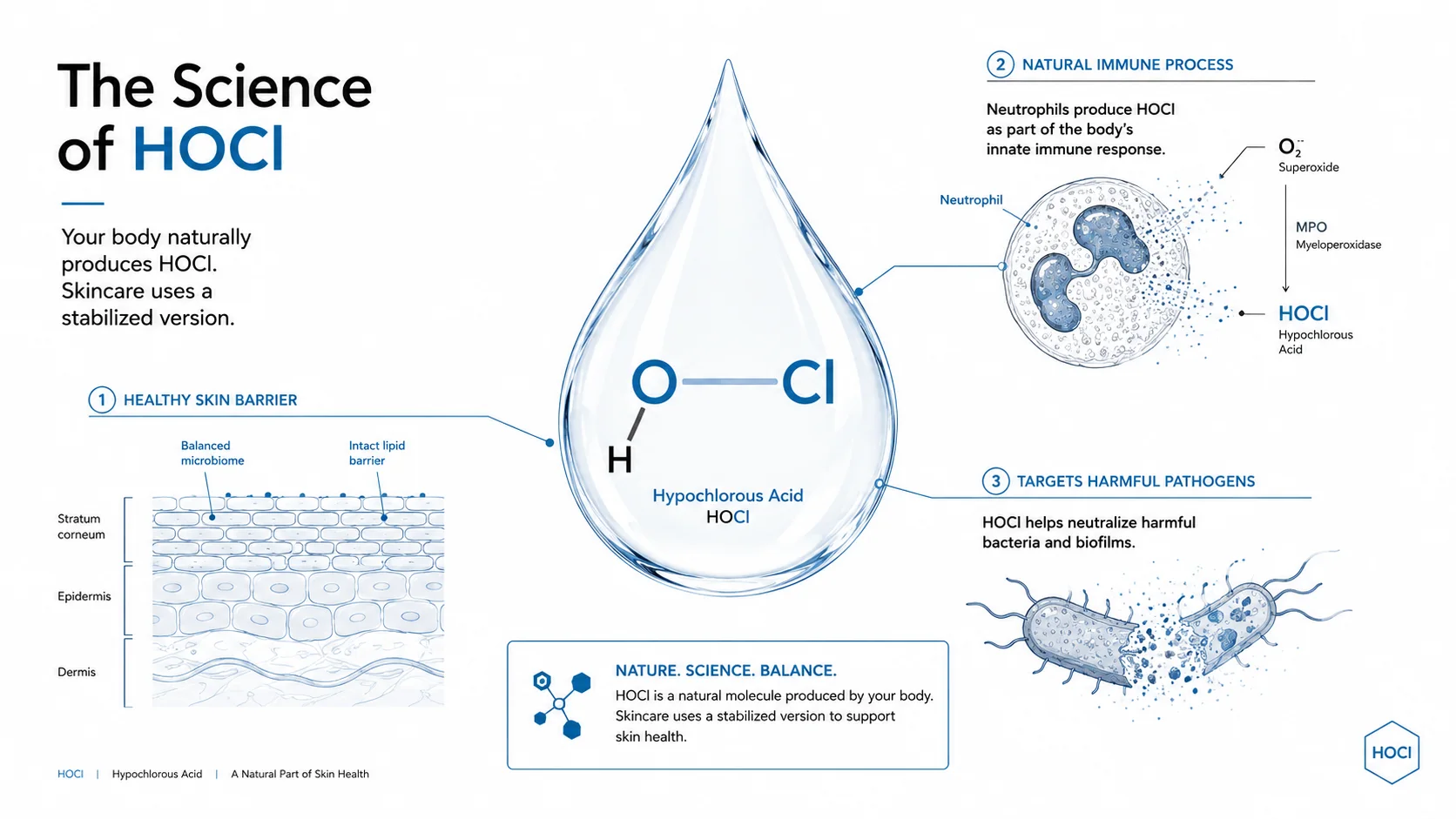
What Is Hypochlorous Acid (HOCl)?
What the dermatology evidence actually supports, where it is weak, and who should bother.
Read the guide